What Influece Has Dramtic Expression Had on Modern Expression of Art?
 Edvard Munch, The Scream, 1893, oil, tempera and pastel on cardboard, 91 ten 73 cm, National Gallery of Kingdom of norway, inspired 20th-century Expressionists. | |
| Years active | The years earlier WWI and the interwar years |
|---|---|
| State | Predominantly Frg, but also in Republic of austria, France, and Russia |
| Major figures | Artists loosely categorized within such groups every bit Die Brücke, Der Blaue Reiter; the Berlin Secession and the Dresden Secession |
| Influenced | American Figurative Expressionism, generally, and Boston Expressionism, in particular |
Expressionism is a modernist move, initially in poetry and painting, originating in Northern Europe effectually the offset of the 20th century. Its typical trait is to present the world solely from a subjective perspective, distorting information technology radically for emotional issue in order to evoke moods or ideas.[i] [2] Expressionist artists have sought to express the significant[3] of emotional experience rather than physical reality.[3] [iv]
Expressionism developed as an advanced style before the Start Earth War. Information technology remained pop during the Weimar Republic,[1] specially in Berlin. The manner extended to a wide range of the arts, including expressionist architecture, painting, literature, theatre, trip the light fantastic toe, film and music.[5]
The term is sometimes suggestive of angst. In a historical sense, much older painters such as Matthias Grünewald and El Greco are sometimes termed expressionist, though the term is applied mainly to 20th-century works. The Expressionist accent on individual and subjective perspective has been characterized equally a reaction to positivism and other artistic styles such equally Naturalism and Impressionism.[6]
Etymology [edit]
While the word expressionist was used in the modern sense every bit early on as 1850, its origin is sometimes traced to paintings exhibited in 1901 in Paris by obscure artist Julien-Auguste Hervé, which he chosen Expressionismes.[seven] An alternative view is that the term was coined by the Czech fine art historian Antonin Matějček in 1910 equally the opposite of Impressionism: "An Expressionist wishes, to a higher place all, to express himself... (an Expressionist rejects) immediate perception and builds on more complex psychic structures... Impressions and mental images that laissez passer through ... people's soul as through a filter which rids them of all substantial accretions to produce their clear essence [...and] are assimilated and condense into more general forms, into types, which he transcribes through simple curt-paw formulae and symbols."[eight]
Important precursors of Expressionism were the German philosopher Friedrich Nietzsche (1844–1900), peculiarly his philosophical novel Thus Spoke Zarathustra (1883–1892); the later plays of the Swedish dramatist August Strindberg (1849–1912), including the trilogy To Damascus 1898–1901, A Dream Play (1902), The Ghost Sonata (1907); Frank Wedekind (1864–1918), specially the "Lulu" plays Erdgeist (Globe Spirit) (1895) and Die Büchse der Pandora (Pandora'due south Box) (1904); the American poet Walt Whitman'southward (1819–1892) Leaves of Grass (1855–1891); the Russian novelist Fyodor Dostoevsky (1821–1881); Norwegian painter Edvard Munch (1863–1944); Dutch painter Vincent van Gogh (1853–1890); Belgian painter James Ensor (1860–1949);[ix] and pioneering Austrian psychoanalyst Sigmund Freud (1856–1939).[5]
In 1905, a grouping of iv German artists, led past Ernst Ludwig Kirchner, formed Die Brücke (the Span) in the metropolis of Dresden. This was arguably the founding arrangement for the German Expressionist movement, though they did not use the word itself. A few years later, in 1911, a agreeing grouping of young artists formed Der Blaue Reiter (The Blue Rider) in Munich. The name came from Wassily Kandinsky'due south Der Blaue Reiter painting of 1903. Among their members were Kandinsky, Franz Marc, Paul Klee, and Baronial Macke. Yet, the term Expressionism did non firmly establish itself until 1913.[ten] Though mainly a German artistic movement initially[11] [5] and most predominant in painting, poetry and the theatre between 1910 and 1930, near precursors of the movement were not High german. Furthermore, there have been expressionist writers of prose fiction, as well every bit not-German-speaking expressionist writers, and, while the motion had declined in Federal republic of germany with the ascension of Adolf Hitler in the 1930s, in that location were subsequent expressionist works.
Expressionism is notoriously difficult to ascertain, in function because it "overlapped with other major 'isms' of the modernist period: with Futurism, Vorticism, Cubism, Surrealism and Dadaism."[12] Richard Murphy also comments, "the search for an all-inclusive definition is problematic to the extent that the almost challenging expressionists such as Kafka, Gottfried Benn and Döblin were simultaneously the most vociferous 'anti-expressionists.'"[13]
What tin can be said, however, is that it was a motion that developed in the early twentieth century, mainly in Federal republic of germany, in reaction to the dehumanizing result of industrialization and the growth of cities, and that "one of the central means by which expressionism identifies itself as an avant-garde movement, and past which it marks its distance to traditions and the cultural institution equally a whole is through its relationship to realism and the dominant conventions of representation."[14] More than explicitly, that the expressionists rejected the ideology of realism.[15]
The term refers to an "artistic style in which the artist seeks to depict not objective reality but rather the subjective emotions and responses that objects and events agitate within a person".[sixteen] It is arguable that all artists are expressive but there are many examples of fine art production in Europe from the 15th century onward which emphasize extreme emotion. Such art often occurs during times of social upheaval and state of war, such as the Protestant Reformation, German Peasants' State of war, and Eighty Years' War between the Spanish and the netherlands, when farthermost violence, much directed at civilians, was represented in propagandist popular prints. These were often unimpressive aesthetically just had the capacity to agitate extreme emotions in the viewer.
Expressionism has been likened to Baroque by critics such as art historian Michel Ragon[17] and German philosopher Walter Benjamin.[18] Co-ordinate to Alberto Arbasino, a deviation between the two is that "Expressionism doesn't shun the violently unpleasant effect, while Baroque does. Expressionism throws some terrific 'fuck yous', Baroque doesn't. Bizarre is well-mannered."[19]
Notable Expressionists [edit]
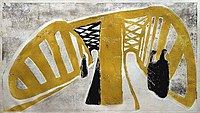
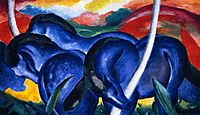
Some of the style's master visual artists of the early on 20th century were:
- Armenia: Martiros Saryan
- Australia: Sidney Nolan, Charles Blackman, John Perceval, Albert Tucker, and Joy Hester
- Republic of austria: Richard Gerstl, Egon Schiele, Oskar Kokoschka, Josef Gassler and Alfred Kubin
- Belgium: Marcel Caron, Anto Carte, and Auguste Mambour, and the Flemish Expressionists: Constant Permeke, Gustave De Smet, Frits Van den Berghe, James Ensor, Albert Servaes, Floris Jespers and Gustave Van de Woestijne.
- Brazil: Anita Malfatti, Cândido Portinari, Di Cavalcanti, Iberê Camargo and Lasar Segall.
- Kingdom of denmark: Einer Johansen
- Estonia: Konrad Mägi, Eduard Wiiralt, Kuno Veeber
- Finland: Tyko Sallinen,[20] Alvar Cawén, and Wäinö Aaltonen.
- France: Frédéric Fiebig, Georges Rouault, Georges Gimel, Gen Paul, Marie-Thérèse Auffray, Jacques Démoulin and Bernard Buffet.
- Deutschland: Ernst Barlach, Max Beckmann, Fritz Bleyl, Heinrich Campendonk, Otto Dix, Conrad Felixmüller, George Grosz, Erich Heckel, Carl Hofer, Max Kaus, Ernst Ludwig Kirchner, Käthe Kollwitz, Wilhelm Lehmbruck, Elfriede Lohse-Wächtler, August Macke, Franz Marc, Ludwig Meidner, Paula Modersohn-Becker, Otto Mueller, Gabriele Münter, Rolf Nesch, Emil Nolde, Max Pechstein, Christian Rohlfs, Karl Schmidt-Rottluff and Georg Tappert.
- Greece: George Bouzianis
- Hungary: Tivadar Kosztka Csontváry
- Iceland: Einar Hákonarson
- Ireland: Jack B. Yeats
- Indonesia: Affandi
- Italia: Amedeo Modigliani, Emilio Giuseppe Dossena
- Japan: Kōshirō Onchi
- Mexico: Mathias Goeritz (German émigré to United mexican states), Rufino Tamayo
- Netherlands: Willem Hofhuizen, Herman Kruyder, Jan Sluyters, Vincent van Gogh, January Wiegers and Hendrik Werkman
- Kingdom of norway: Edvard Munch, Kai Fjell
- Poland: Henryk Gotlib
- Portugal: Mário Eloy, Amadeo de Souza Cardoso
- Russia: Wassily Kandinsky, Marc Chagall, Chaïm Soutine, Alexej von Jawlensky, Natalia Goncharova, Mstislav Dobuzhinsky, and Marianne von Werefkin (Russian-born, after active in Germany and Switzerland).
- Romania: Horia Bernea
- S Africa: Maggie Laubser, Irma Stern
- Sweden: Leander Engström, Isaac Grünewald, Axel Törneman
- Switzerland: Carl Eugen Keel, Cuno Amiet, Paul Klee
- Ukraine: Alexis Gritchenko (Ukraine-born, most active in France), Vadim Meller
- United Kingdom: Francis Salary, Frank Auerbach, Leon Kossoff, Lucian Freud, Patrick Heron, John Hoyland, Howard Hodgkin, John Walker
- U.s.: Ivan Albright, David Aronson, Milton Avery, Leonard Baskin, George Biddle, Hyman Bloom, Peter Blume, Charles Burchfield, David Burliuk, Stuart Davis, Lyonel Feininger, Wilhelmina Weber Furlong, Elaine de Kooning, Willem de Kooning, Beauford Delaney, Arthur G. Dove, Norris Embry, Philip Evergood, Kahlil Gibran, William Gropper, Philip Guston, Marsden Hartley, Albert Kotin, Yasuo Kuniyoshi, Rico Lebrun, Jack Levine, Alfred Henry Maurer, Robert Motherwell, Alice Neel, Abraham Rattner, Esther Rolick, Ben Shahn, Harry Shoulberg, Joseph Stella, Harry Sternberg, Henry Ossawa Tanner, Dorothea Tanning, Wilhelmina Weber, Max Weber, Hale Woodruff, Karl Zerbe.
Groups of painters [edit]

The fashion originated principally in Germany and Austria. There were a number of groups of expressionist painters, including Der Blaue Reiter and Die Brücke. Der Blaue Reiter (The Blue Rider, named for a painting) was based in Munich and Die Brücke was originally based in Dresden (although some members later relocated to Berlin). Dice Brücke was agile for a longer flow than Der Blaue Reiter, which was just together for a year (1912). The Expressionists were influenced by various artists and sources including Edvard Munch, Vincent van Gogh, and African art.[21] They were also aware of the work beingness done past the Fauves in Paris, who influenced Expressionism's trend toward arbitrary colours and jarring compositions. In reaction and opposition to French Impressionism, which emphasized the rendering of the visual advent of objects, Expressionist artists sought to portray emotions and subjective interpretations. It was not of import to reproduce an aesthetically pleasing impression of the artistic field of study thing, they felt, just rather to represent vivid emotional reactions by powerful colours and dynamic compositions. Kandinsky, the primary artist of Der Blaue Reiter group, believed that with simple colours and shapes the spectator could perceive the moods and feelings in the paintings, a theory that encouraged him towards increased brainchild.[5]
The ideas of German expressionism influenced the work of American artist Marsden Hartley, who met Kandinsky in Federal republic of germany in 1913.[22] In late 1939, at the beginning of World War II, New York City received a bully number of major European artists. Afterward the state of war, Expressionism influenced many young American artists. Norris Embry (1921–1981) studied with Oskar Kokoschka in 1947 and during the next 43 years produced a large body of work in the Expressionist tradition. Norris Embry has been termed "the first American German Expressionist". Other American artists of the late 20th and early on 21st century have developed distinct styles that may be considered function of Expressionism. Another prominent creative person who came from the German Expressionist "schoolhouse" was Bremen-built-in Wolfgang Degenhardt. After working every bit a commercial artist in Bremen, he migrated to Australia in 1954 and became quite well known in the Hunter Valley region.
Subsequently World State of war 2, figurative expressionism influenced worldwide a big number of artists and styles. In the U.Due south., American Expressionism[23] and American Figurative Expressionism, particularly Boston Expressionism,[24] were an integral part of American modernism around the 2d Earth War. Thomas B. Hess wrote that "the 'New figurative painting' which some have been expecting as a reaction against Abstruse Expressionism was implicit in it at the start, and is one of its well-nigh lineal continuities."[25]
- Major figurative Boston Expressionists included: Karl Zerbe, Hyman Bloom, Jack Levine, David Aronson. The Boston Expressionists persisted later Earth War Ii despite their marginalization by the development of abstract expressionism centered in New York City, and are currently in the 3rd generation.
- New York Figurative Expressionism[26] [27] of the 1950s represented New York figurative artists such equally Robert Beauchamp, Elaine de Kooning, Robert Goodnough, Grace Hartigan, Lester Johnson, Alex Katz, George McNeil (creative person), Jan Muller, Fairfield Porter, Gregorio Prestopino, Larry Rivers and Bob Thompson.
- Lyrical Abstraction, Tachisme[28] of the 1940s and 1950s in Europe represented by artists such every bit Georges Mathieu, Hans Hartung, Nicolas de Staël and others.
- Bay Expanse Figurative Movement[29] [30] represented by early figurative expressionists from the San Francisco expanse Elmer Bischoff, Richard Diebenkorn, and David Park. The motion from 1950 to 1965 was joined by Theophilus Brownish, Paul Wonner, Hassel Smith, Nathan Oliveira, Jay DeFeo, Joan Brown, Manuel Neri, Frank Lobdell, and Roland Peterson.
- Abstract expressionism of the 1950s represented American artists such equally Louise Conservative, Hans Burkhardt, Mary Callery, Nicolas Carone, Willem de Kooning, Jackson Pollock, Philip Guston, and others[31] [32] that participated with figurative expressionism.
- Sōsaku-hanga (創作版画 "creative prints") was an expressionist woodblock print movement in early 20th century Japan. The move was characterized by the work of Kanae Yamamoto (artist), Kōshirō Onchi, and many others.
- In the United States and Canada, Lyrical Abstraction outset during the late 1960s and the 1970s. Characterized by the work of Dan Christensen, Peter Young, Ronnie Landfield, Ronald Davis, Larry Poons, Walter Darby Bannard, Charles Arnoldi, Pat Lipsky and many others.[33] [34] [35]
- Neo-expressionism was an international revival style that began in the belatedly 1970s
Representative paintings [edit]
In other arts [edit]
The Expressionist movement included other types of civilization, including trip the light fantastic, sculpture, movie theatre and theatre.
Trip the light fantastic toe [edit]
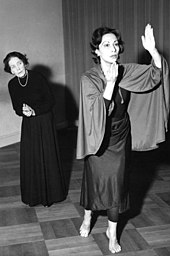
Exponents of expressionist dance included Mary Wigman, Rudolf von Laban, and Pina Bausch.[36]
Sculpture [edit]
Some sculptors used the Expressionist style, as for case Ernst Barlach. Other expressionist artists known mainly every bit painters, such as Erich Heckel, also worked with sculpture.[v]
Picture palace [edit]
At that place was an Expressionist manner in German language picture palace, of import examples of which are Robert Wiene's The Cabinet of Dr. Caligari (1920), The Golem: How He Came into the Globe (1920), Fritz Lang'southward Urban center (1927) and F. W. Murnau'due south Nosferatu, a Symphony of Horror (1922) and The Last Laugh (1924). The term "expressionist" is also sometimes used to refer to stylistic devices thought to resemble those of German Expressionism, such as film noir cinematography or the style of several of the films of Ingmar Bergman. More than generally, the term expressionism tin can be used to describe cinematic styles of great bamboozlement, such as the technicolor melodramas of Douglas Sirk or the sound and visual pattern of David Lynch's films.[37]
Literature [edit]
Journals [edit]
Two leading Expressionist journals published in Berlin were Der Sturm, published by Herwarth Walden starting in 1910,[38] and Dice Aktion, which commencement appeared in 1911 and was edited by Franz Pfemfert. Der Sturm published verse and prose from contributors such every bit Peter Altenberg, Max Brod, Richard Dehmel, Alfred Döblin, Anatole France, Knut Hamsun, Arno Holz, Karl Kraus, Selma Lagerlöf, Adolf Loos, Heinrich Mann, Paul Scheerbart, and René Schickele, and writings, drawings, and prints past such artists every bit Kokoschka, Kandinsky, and members of Der blaue Reiter.[39]
Drama [edit]
The artist and playwright Oskar Kokoschka's 1909 playlet, Murderer, The Hope of Women is often termed the first expressionist drama. In it, an unnamed human being and woman struggle for authority. The man brands the woman; she stabs and imprisons him. He frees himself and she falls dead at his affect. Every bit the play ends, he slaughters all around him (in the words of the text) "like mosquitoes." The farthermost simplification of characters to mythic types, choral effects, declamatory dialogue and heightened intensity all would become characteristic of later expressionist plays.[twoscore] The German composer Paul Hindemith created an operatic version of this play, which premiered in 1921.[41]
Expressionism was a dominant influence on early on 20th-century German theatre, of which Georg Kaiser and Ernst Toller were the nigh famous playwrights. Other notable Expressionist dramatists included Reinhard Sorge, Walter Hasenclever, Hans Henny Jahnn, and Arnolt Bronnen. Important precursors were the Swedish playwright Baronial Strindberg and German language actor and dramatist Frank Wedekind. During the 1920s, Expressionism enjoyed a brief menses of influence in American theatre, including the early modernist plays by Eugene O'Neill (The Hairy Ape, The Emperor Jones and The Slap-up God Brown), Sophie Treadwell (Machinal) and Elmer Rice (The Adding Motorcar).[42]
Expressionist plays frequently dramatise the spiritual enkindling and sufferings of their protagonists. Some apply an episodic dramatic structure and are known as Stationendramen (station plays), modeled on the presentation of the suffering and expiry of Jesus in the Stations of the Cross. August Strindberg had pioneered this class with his autobiographical trilogy To Damascus. These plays also often dramatise the struggle against bourgeois values and established authority, oft personified by the Father. In Sorge's The Beggar, (Der Bettler), for instance, the young hero's mentally ill father raves near the prospect of mining the riches of Mars and is finally poisoned by his son. In Bronnen's Parricide (Vatermord), the son stabs his tyrannical male parent to expiry, only to have to fend off the frenzied sexual overtures of his mother.[43]
In Expressionist drama, the speech may be either expansive and rhapsodic, or clipped and telegraphic. Director Leopold Jessner became famous for his expressionistic productions, often set on stark, steeply raked flights of stairs (having borrowed the idea from the Symbolist director and designer, Edward Gordon Craig). Staging was particularly important in Expressionist drama, with directors forgoing the illusion of reality to cake actors in as close to two-dimensional motion. Directors also made heavy employ of lighting furnishings to create stark contrast and as another method to heavily emphasize emotion and convey the play or a scene'due south message.[44]
German language expressionist playwrights:
- Georg Kaiser (1878)
- Ernst Toller (1893–1939)
- Hans Henny Jahnn (1894–1959)
- Reinhard Sorge (1892–1916)
- Bertolt Brecht (1898–1956)
Playwrights influenced by Expressionism:
- Seán O'Casey (1880–1964)[45]
- Eugene O'Neill (1885–1953)
- Elmer Rice (1892–1967)
- Tennessee Williams (1911–1983)[46]
- Arthur Miller (1915–2005)
- Samuel Beckett (1906–1989)[47]
Verse [edit]
Among the poets associated with German Expressionism were:
- Jakob van Hoddis
- Georg Trakl
- Walter Rheiner
- Gottfried Benn
- Georg Heym
- Else Lasker-Schüler
- Ernst Stadler
- August Stramm
- Rainer Maria Rilke (1875–1926): The Notebooks of Malte Laurids Brigge (1910)[48]
- Geo Milev
Other poets influenced by expressionism:
- T. South. Eliot[49]
- Rudolf Broby-Johansen[50]
- Tom Kristensen
- Pär Lagerkvist
- Edith Södergran
Prose [edit]
In prose, the early stories and novels of Alfred Döblin were influenced past Expressionism,[51] and Franz Kafka is sometimes labelled an Expressionist.[52] Some further writers and works that have been called Expressionist include:
- Franz Kafka (1883–1924): "The Metamorphosis" (1915), The Trial (1925), The Castle (1926)[53]
- Alfred Döblin (1878–1957): Berlin Alexanderplatz (1929)[54]
- Wyndham Lewis (1882–1957)[55]
- Djuna Barnes (1892–1982): Nightwood (1936)[56]
- Malcolm Lowry (1909–1957): Under the Volcano (1947)
- Ernest Hemingway[57]
- James Joyce (1882–1941): "The Nighttown" section of Ulysses (1922)[58]
- Patrick White (1912–1990)[59]
- D. H. Lawrence[lx]
- Sheila Watson: Double Claw [61]
- Elias Canetti: Car-da-Fé [62]
- Thomas Pynchon[63]
- William Faulkner[64]
- James Hanley (1897–1985)[65]
- Raul Brandão (1867–1930): Húmus (1917)
Music [edit]
The term expressionism "was probably kickoff applied to music in 1918, especially to Schoenberg", because like the painter Kandinsky he avoided "traditional forms of dazzler" to convey powerful feelings in his music.[66] Arnold Schoenberg, Anton Webern and Alban Berg, the members of the Second Viennese School, are important Expressionists (Schoenberg was also an expressionist painter).[67] Other composers that have been associated with expressionism are Krenek (the Second Symphony), Paul Hindemith (The Young Maiden), Igor Stravinsky (Japanese Songs), Alexander Scriabin (late piano sonatas) (Adorno 2009, 275). Another significant expressionist was Béla Bartók in early works, written in the 2d decade of the 20th century, such every bit Bluebeard'south Castle (1911),[68] The Wooden Prince (1917),[69] and The Miraculous Mandarin (1919).[70] Important precursors of expressionism are Richard Wagner (1813–1883), Gustav Mahler (1860–1911), and Richard Strauss (1864–1949).[71]
Theodor Adorno describes expressionism as concerned with the unconscious, and states that "the depiction of fearfulness lies at the centre" of expressionist music, with noise predominating, and so that the "harmonious, affirmative element of art is banished" (Adorno 2009, 275–76). Erwartung and Die Glückliche Hand, by Schoenberg, and Wozzeck, an opera by Alban Berg (based on the play Woyzeck by Georg Büchner), are examples of Expressionist works.[72] If one were to draw an analogy from paintings, ane may describe the expressionist painting technique as the distortion of reality (mostly colors and shapes) to create a nightmarish effect for the particular painting equally a whole. Expressionist music roughly does the same thing, where the dramatically increased dissonance creates, aurally, a nightmarish atmosphere.[73]
Architecture [edit]

In architecture, two specific buildings are identified equally Expressionist: Bruno Taut's Glass Pavilion of the Cologne Werkbund Exhibition (1914), and Erich Mendelsohn's Einstein Tower in Potsdam, Germany completed in 1921. The interior of Hans Poelzig'southward Berlin theatre (the Grosse Schauspielhaus), designed for the manager Max Reinhardt, is also cited sometimes. The influential architectural critic and historian Sigfried Giedion, in his book Infinite, Time and Architecture (1941), dismissed Expressionist architecture as a role of the development of functionalism. In Mexico, in 1953, German émigré Mathias Goeritz published the Arquitectura Emocional ("Emotional Architecture") manifesto with which he declared that "architecture's chief function is emotion".[74] Modernistic Mexican builder Luis Barragán adopted the term that influenced his work. The two of them collaborated in the project Torres de Satélite (1957–58) guided by Goeritz's principles of Arquitectura Emocional.[75] Information technology was simply during the 1970s that Expressionism in architecture came to be re-evaluated more positively.[76] [77]
References [edit]
- ^ a b Bruce Thompson, University of California, Santa Cruz, lecture on Weimar culture/Kafka'a Prague Archived 2010-01-eleven at the Wayback Machine
- ^ Chris Baldick Concise Oxford Lexicon of Literary Terms, entry for Expressionism
- ^ a b Victorino Tejera, 1966, pages 85,140, Fine art and Man Intelligence, Vision Press Express, London
- ^ The Oxford Illustrated Lexicon, 1976 edition, page 294
- ^ a b c d eastward Gombrich, Eastward.H. (1995). The Story of Art (16. ed. (rev., expanded and redesigned). ed.). London: Phaidon. pp. 563–568. ISBN978-0714832470.
- ^ Garzanti, Aldo (1974) [1972]. Enciclopedia Garzanti della letteratura (in Italian). Milan: Guido Villa. p. 963. folio 241
- ^ John Willett, Expressionism. New York: Globe University Library, 1970, p.25; Richard Sheppard, "German Expressionism", in Modernism: 1890–1930, ed. Bradbury & McFarlane, Harmondsworth: Penguin Books, 1976, p.274.
- ^ Cited in Donald E. Gordon, Expressionism: Art and Ideas. New Haven: Yale University Press, 1987, p. 175.
- ^ R. S. Furness, Expressionism. London: Methuen, pp.2–14; Willett, pp. 20–24.
- ^ Richard Sheppard, p.274.
- ^ Note the parallel French movement Fauvism and the English language Vorticism: "The Fauvist movement has been compared to German Expressionism, both projecting brilliant colors and spontaneous brushwork, and indebted to the same belatedly nineteenth-century sources, especially Van Gogh." Sabine Rewald, "Fauvism", In Heilbrunn Timeline of Art History. New York: The Metropolitan Museum of Art, 2000–. http://www.metmuseum.org/toah/hd/fauv/hd_fauv.htm (Oct 2004); and "Vorticism tin be thought of equally English language Expressionism." Sherrill E. Grace, Regression and Apocalypse: Studies in North American Literary Expressionism. Toronto: University of Toronto Press, 1989, p. 26.
- ^ Sherrill E. Grace, Regression and Apacaypse: Studies in North American Literary Expressionism. Toronto: University of Toronto Press, 1989, p.26).
- ^ Richard Irish potato, Theorizing the Advanced: Modernism, Expressionism, and the Trouble of Postmodernity. Cambridge, Cambridge University Press,1999, p. 43.
- ^ Richard White potato, p. 43.
- ^ Murphy, especially pp. 43–48; and Walter H. Sokel, The Author in Extremis. Stanford, California: Stanford University Press, 1959, especially Chapter One.
- ^ Britannica Online Encyclopaedia (February, 2012).
- ^ Ragon, Michel (1968). Expressionism . Heron. ISBN9780900948640.
There is no uncertainty that Expressionism is Baroque in essence
- ^ Benjamin, Walter (1998). Origin of German Tragic Drama . London: Verso. ISBN978-ane-85984-899-nine.
- ^ Pedullà, Gabriele; Arbasino, Alberto (2003). "Sull'albero di ciliegie – Conversando di letteratura due east di cinema con Alberto Arbasino" [On the cherry tree – Conversations on literature and cinema with Alberto Arbasino]. CONTEMPORANEA Rivista di studi sulla letteratura e sulla comunicazione.
L'espressionismo non rifugge dall'effetto violentemente sgradevole, mentre invece il barocco lo fa. Fifty'espressionismo tira dei tremendi «vaffanculo», il barocco no. Il barocco è beneducato (Expressionism doesn't shun the violently unpleasant effect, while Baroque does. Expressionism throws some terrific "Fuck you", Bizarre doesn't. Baroque is well-mannered.)
- ^ Ian Chilvers, The Oxford dictionary of art, Volume 2004, Oxford Academy Press, p. 506. ISBN 0-19-860476-9
- ^ Ian Buruma, "Want in Berlin", New York Review of Books, Dec viii, 2008, p. 19.
- ^ "Hartley, Marsden", Oxford Art Online
- ^ Bram Dijkstra, American expressionism : art and social modify, 1920–1950,(New York : H.N. Abrams, in association with the Columbus Museum of Art, 2003.) ISBN 0-8109-4231-iii, ISBN 978-0-8109-4231-eight
- ^ Judith Bookbinder, Boston modern: figurative expressionism every bit alternative modernism (Durham, N.H. : University of New Hampshire Press; Hanover : University Press of New England, ©2005.) ISBN 1-58465-488-0, ISBN 978-1-58465-488-9
- ^ Thomas B. Hess, "The Many Deaths of American Fine art," Art News 59 (October 1960), p.25
- ^ Paul Schimmel and Judith Eastward Stein, The Figurative fifties : New York figurative expressionism (Newport Beach, California : Newport Harbor Art Museum : New York : Rizzoli, 1988.) ISBN 978-0-8478-0942-4
- ^ "Editorial," Reality, A Journal of Artists' Opinions (Leap 1954), p. 2.
- ^ Flight lyric, Paris 1945–1956, texts Patrick-Gilles Persin, Michel and Pierre Descargues Ragon, Musée du Grand duchy of luxembourg, Paris and Skira, Milan, 2006, 280 p. ISBN 88-7624-679-seven.
- ^ Caroline A. Jones, Bay Area figurative fine art, 1950–1965, (San Francisco, California : San Francisco Museum of Modern Fine art; Berkeley : University of California Press, ©1990.) ISBN 978-0-520-06842-ane
- ^ American Abstract and Figurative Expressionism: Style Is Timely Art Is Timeless (New York School Printing, 2009.) ISBN 978-0-9677994-two-i pp. 44–47; 56–59; 80–83; 112–115; 192–195; 212–215; 240–243; 248–251
- ^ Marika Herskovic, American Abstract Expressionism of the 1950s An Illustrated Survey, (New York Schoolhouse Printing, 2000. ISBN 0-9677994-1-4. pp. 46–49; pp. 62–65; pp. 70–73; pp. 74–77; pp. 94–97; 262–264
- ^ American Abstract and Figurative Expressionism: Way Is Timely Fine art Is Timeless: An Illustrated Survey With Artists' Statements, Artwork and Biographies(New York School Press, 2009. ISBN 978-0-9677994-ii-1. pp.24–27; pp.28–31; pp.32–35; pp. sixty–63; pp.64–67; pp.72–75; pp.76–79; pp. 112–115; 128–131; 136–139; 140–143; 144–147; 148–151; 156–159; 160–163;
- ^ Ryan, David (2002). Talking painting: dialogues with twelve gimmicky abstract painters, p.211, Routledge. ISBN 0-415-27629-2, ISBN 978-0-415-27629-0. Available on Google Books.
- ^ "Exhibition archive: Expanding Boundaries: Lyrical Abstraction", Boca Raton Museum of Art, 2009. Retrieved 25 September 2009.
- ^ "John Seery", National Gallery of Australia. Retrieved 25 September 2009.
- ^ Walther, Suzanne (23 December 1997). The Dance Theatre of Kurt Jooss. Routledge. p. 23. ISBN978-1-135-30564-2 . Retrieved 29 May 2018.
- ^ Maria Pramaggiore; Tom Wallis (2005). Motion-picture show: A Critical Introduction . Laurence Rex Publishing. pp. 88–90. ISBN978-1-85669-442-i . Retrieved 29 May 2018.
- ^ "Der Sturm.". Encyclopædia Britannica Online. Encyclopædia Britannica Inc. 2012. Retrieved 21 January 2012.
- ^ Günter Berghaus (25 October 2012). International Futurism in Arts and Literature. Walter de Gruyter. pp. 285–286. ISBN978-3-11-080422-5 . Retrieved 29 May 2018.
- ^ David Graver (1995). The Aesthetics of Disturbance: Anti-art in Avant-garde Drama. University of Michigan Press. p. 65. ISBN0-472-10507-8 . Retrieved 29 May 2018.
- ^ John Lincoln Stewart (1991). Ernst Krenek: The Man and His Music. Academy of California Press. p. 82. ISBN978-0-520-07014-ane . Retrieved 29 May 2018.
- ^ Jonathan Law (28 Oct 2013). The Methuen Drama Lexicon of the Theatre. A&C Black. ISBN978-1-4081-4591-3 . Retrieved 29 May 2018.
- ^ J. L. Styan (nine June 1983). Modern Drama in Theory and Practice: Volume 3, Expressionism and Epic Theatre. Cambridge University Press. p. 4. ISBN978-0-521-29630-four . Retrieved 29 May 2018.
- ^ Fulton, A. R. (1944). "Expressionism: Twenty Years After". The Sewanee Review. 52 (3): 398–399. JSTOR 27537525.
- ^ Furness, pp.89–90.
- ^ Stokel, p.ane.
- ^ Stokel, p.1; Lois Oppenheimer, The Painted Discussion: Samuel Beckett's Dialogue with Art. Ann Arbor: University of Michigan Printing, 2000, pp.74, 126–7, 128; Jessica Prinz, "Resonant Images: Beckett and German Expressionism", in Samuel Beckett and the Arts: Music, Visual Arts, and Non-Impress Media, ed. Lois Oppenheim. New York: Garland Publishing, 1999.
- ^ Ulf Zimmermann, "Expressionism and Döblin's Berlin Alexanderplatz, in Passion and Rebellion
- ^ R. S. Furness, Expressionism. London: Methuen, 1973, p.81.
- ^ "Lyrisk ekspressionisme | lex.dk".
- ^ Cowan, Michael (2007). "Die Tücke Des Körpers: Taming The Nervous Trunk In Alfred Döblin'southward 'Die Ermordung Einer Butterblume' And 'Die Tänzerin Und Der Leib'". Seminar: A Periodical of Germanic Studies. 43 (4): 482–498. doi:ten.3138/seminar.43.4.482.
- ^ Walter H. Sokel, The Writer in Extremis. Stanford, California: Stanford University Press, 1959, pp 3, 29, 84 especially; Richard Potato, Theorizing the Avant-garde. Cambridge, Cambridge University Press,1999, especially pp 41,142.
- ^ Silvio Vietta, Franz Kafka, Expressionism, and Reification" in Passion and Rebellion: The Expressionist Heritage, eds. Stephen Bronner and Douglas Kellner. New York: Universe Books, 1983 pp, pp.201–16.
- ^ Richard White potato, Theorizing the Avant-Garde: Modernism, Expressionism and the Problem of Postmodernity. Cambridge: Cambridge University Printing, 1999, pp.74–141; Ulf Zimmermann, "Expressionism and Döblin'due south Berlin Alexanderplatz " in Passion and Rebellion, pp.217–234.
- ^ Sheila Watson, Wyndham Lewis Expressionist. Ph.D Thesis, Academy of Toronto, 1965.
- ^ Sherrill E. Grace, Regression and Apocalypse: Studies in North American Literary Expressionism. Toronto: University of Toronto Press, 1989, pp.141–162.
- ^ Raymond Due south. Nelson, Hemingway, Expressionist Artist. Ames, Iowa Academy Press, 1979; Robert Paul Lamb, Art matters: Hemingway, Craft, and the Creation of the Modern Brusque Story. Baton Rouge: Louisiana Country University Press, c.2010.
- ^ Walter H. Sokel, The Writer in Extremis. Stanford, California: Stanford University Printing, 1959, p.1; R. S. Furness, Expressionism. London: Methuen, 1973, p. 81.
- ^ Sherrill East. Grace, p.7.
- ^ Sherrill Due east. Grace, p.7
- ^ Sherrill E. Grace, pp 185–209.
- ^ Sherrill Due east. Grace, p.12.
- ^ Sherrill E. Grace, p.7, 241–iii.
- ^ Jeffrey Stayton, "Southern Expressionism: Apocalyptic Hillscapes, Racial Panoramas, and Lustmord in William Faulkner'south Light in August". The Southern Literary Periodical, Volume 42, Number 1, Fall 2009, pp. 32–56.
- ^ Ken Worpole, Dockers and Detectives. London: Verso Editions, 1983, pp. 77–93.
- ^ The Norton Grove Concise Encyclopedia of Music, ed Stanley Sadie. New York: Norton1991, p. 244.
- ^ Theodor Adorno, Dark Music: Essays on Music 1928–1962. (London: Seagull, 2009), p.274-8.
- ^ Nicole V. Gagné, Historical Dictionary of Modern and Contemporary Classical Music (Plymouth, England: Scarecrow Press, 2011), p.92.
- ^ Andrew Clements, "Classical preview: The Wooden Prince", The Guardian, 5 May 2007.
- ^ The Cambridge Companion to Bartók, ed. Amanda Bayley (Cambridge: Cambridge University Press, 2001), p.152.
- ^ "Expressionism," Microsoft® Encarta® Online Encyclopedia 2000. "Archived copy". Archived from the original on 2009-10-xxx. Retrieved 2012-06-29 .
{{cite web}}: CS1 maint: archived copy as title (link); Donald Mitchell, Gustav Mahler: The Wunderhorn Years: Chronicles and Commentaries. Rochester, NY: Boydell Press, 2005 - ^ Edward Rothstein New York Times Review/Opera: "Wozzeck; The Lyric Dresses Up Berg's 1925 Nightmare In a Modern Bulletin". New York Times February 3, 1994; Theodor Adorno, Night Music (2009), p.276.
- ^ Theodor Adorno, Night Music (2009), pp275-6.
- ^ Mathias Goeritz, "El manifiesto de arquitectura emocional", in Lily Kassner, Mathias Goeritz, UNAM, 2007, p. 272-273
- ^ George F. Flaherty (16 August 2016). Hotel Mexico: Dwelling on the '68 Movement. Univ of California Press. p. 93. ISBN978-0-520-29107-2 . Retrieved 29 May 2018.
- ^ Ben Farmer; Dr Hentie J Louw; Hentie Louw; Adrian Napper (2 September 2003). Companion to Contemporary Architectural Thought. Routledge. p. 359. ISBN978-1-134-98381-0 . Retrieved 29 May 2018.
- ^ Dennis Sharp (2002). Twentieth Century Architecture: A Visual History. Images Publishing. p. 297. ISBN978-i-86470-085-five . Retrieved 29 May 2018.
Farther reading [edit]
- Antonín Matějček cited in Gordon, Donald E. (1987). Expressionism: Art and Idea, p. 175. New Oasis: Yale University Printing. ISBN 9780300033106
- Jonah F. Mitchell (Berlin, 2003). Doctoral thesis Expressionism between Western modernism and Teutonic Sonderweg. Courtesy of the author.
- Friedrich Nietzsche (1872). The Birth of Tragedy Out of The Spirit of Music. Trans. Clifton P. Fadiman. New York: Dover, 1995. ISBN 0-486-28515-four.
- Judith Bookbinder, Boston modernistic: figurative expressionism as alternative modernism, (Durham, N.H.: University of New Hampshire Printing; Hanover: Academy Press of New England, ©2005.) ISBN 1-58465-488-0, ISBN 978-i-58465-488-9
- Bram Dijkstra, American expressionism: fine art and social modify, 1920–1950, (New York: H.Northward. Abrams, in clan with the Columbus Museum of Art, 2003.) ISBN 0-8109-4231-3, ISBN 978-0-8109-4231-8
- Ditmar Elger Expressionism-A Revolution in German Art ISBN 978-3-8228-3194-six
- Paul Schimmel and Judith E Stein, The Figurative fifties: New York figurative expressionism, The Other Tradition (Newport Beach, California: Newport Harbor Art Museum: New York: Rizzoli, 1988.) ISBN 978-0-8478-0942-4 ISBN 978-0-91749312-half-dozen
- Marika Herskovic, American Abstract and Figurative Expressionism: Style Is Timely Art Is Timeless (New York School Press, 2009.) ISBN 978-0-9677994-two-1.
- Lakatos Gabriela Luciana, Expressionism Today, University of Art and Design Cluj Napoca, 2011
External links [edit]
- Hottentots in tails A turbulent history of the group by Christian Saehrendt at signandsight.com
- German Expressionism A complimentary resource with paintings from German expressionists (high-quality).
Source: https://en.wikipedia.org/wiki/Expressionism
0 Response to "What Influece Has Dramtic Expression Had on Modern Expression of Art?"
Post a Comment